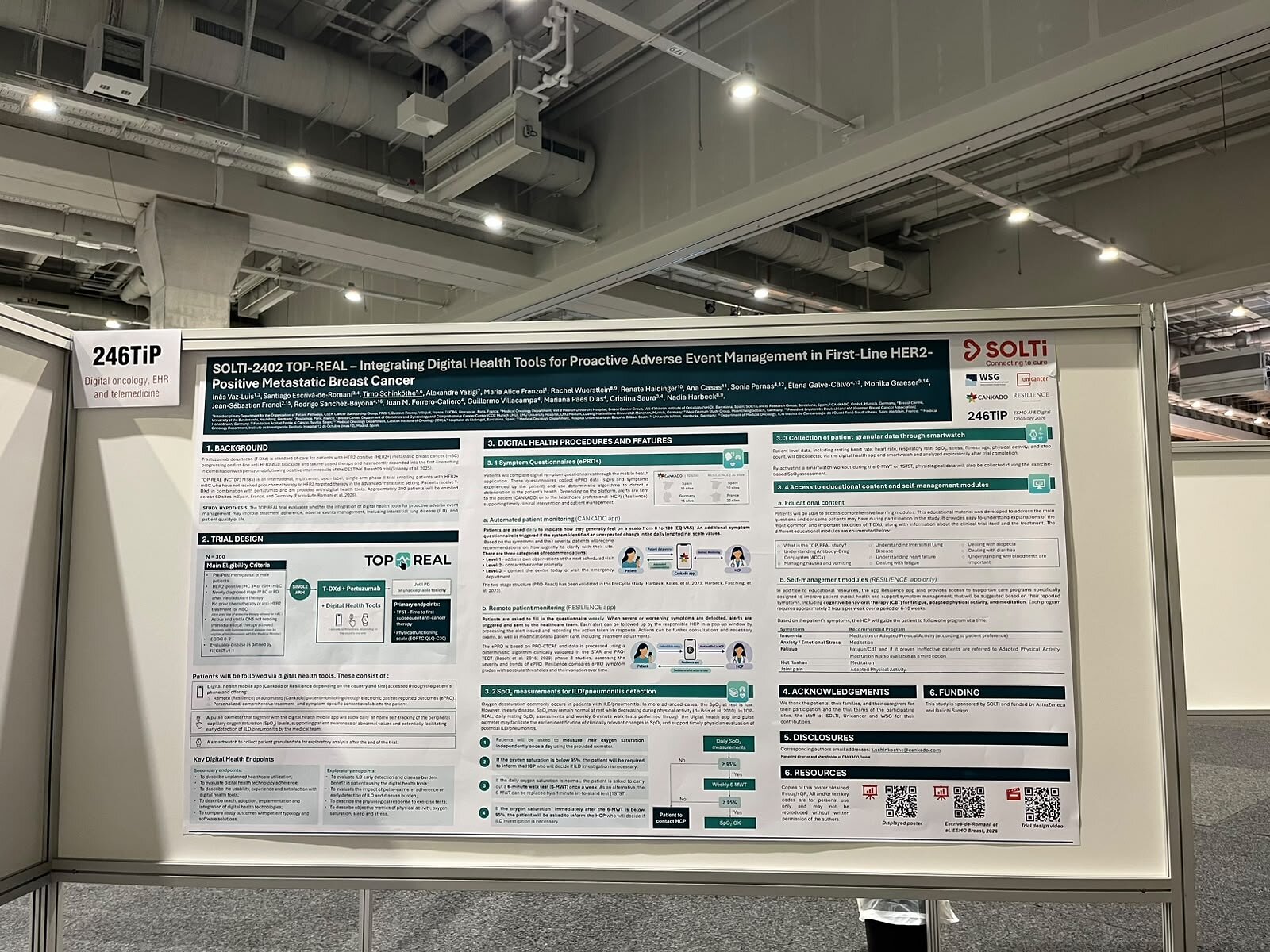
Solti, an academic clinical cancer research group, has presented the design of TOP-REAL, an international phase II trial of a proactive monitoring model for patients with advanced or metastatic HER2-positive breast cancer. The presentation took place at the ESMO AI & Digital Oncology 2026 congress, according to a Solti statement dated 21 November 2026 in Barcelona. Participants receive first-line trastuzumab deruxtecan (T-DXd) plus pertuzumab.
What the trial will test
The study asks whether spotting symptoms and physiological changes between hospital visits can lead to earlier assessment and more timely handling of toxicities, before they worsen and threaten continuity of treatment. Monitoring combines a mobile app (CANKADO or Resilience, depending on country and centre), electronic patient-reported outcomes (ePROs), pulse oximetry and smartwatch tracking. Depending on the platform, recommendations or alerts may be generated.
Speaking in Solti's statement, Dr Cristina Saura, a TOP-REAL principal investigator at Vall d'Hebron University Hospital, said the goal is to shift from waiting for patients to raise problems at clinic visits towards anticipating those problems.
One toxicity under specific assessment is interstitial lung disease or pneumonitis linked to T-DXd. The protocol includes daily oxygen-saturation readings and periodic exercise tests to explore whether certain changes could prompt earlier medical review. Solti describes this approach as exploratory.
Who is enrolling
Led by Solti in Spain with Unicancer in France and the West German Study Group (WSG) in Germany, the trial plans to include roughly 300 patients across 60 centres. According to Solti, it is active in all three countries: patients are already participating in Spain and France, and recruitment has begun in Germany. It is supported by AstraZeneca and Daiichi Sankyo.
The trial aims to include profiles underrepresented in registration studies, such as selected patients with active brain metastases or an ECOG performance status of 2. It will also assess treatment benefit and continuity until the first subsequent cancer treatment, and health-related quality of life using the EORTC QLQ-C30 questionnaire. Further elements are the feasibility and safety of re-treatment with T-DXd in selected patients, and tumour biopsy and blood analyses on biomarkers tied to response and toxicity.
Background on the drug
The European Medicines Agency lists T-DXd, sold as Enhertu, as conditionally authorised in the EU since 18 January 2021. The EMA says that in a study of HER2-positive metastatic or inoperable breast cancer in adults not previously treated for advanced or metastatic disease, patients on Enhertu with pertuzumab had a median of 41 months without disease worsening, versus 27 months on the comparator. The agency also notes that interstitial lung disease and pneumonitis may affect more than 1 in 10 people and can be severe in up to 2 in 100, but are generally reversible and manageable through close monitoring and dose adjustment.