World
Activists urge Eisenkot to form new Israeli gov’t with Arab parties
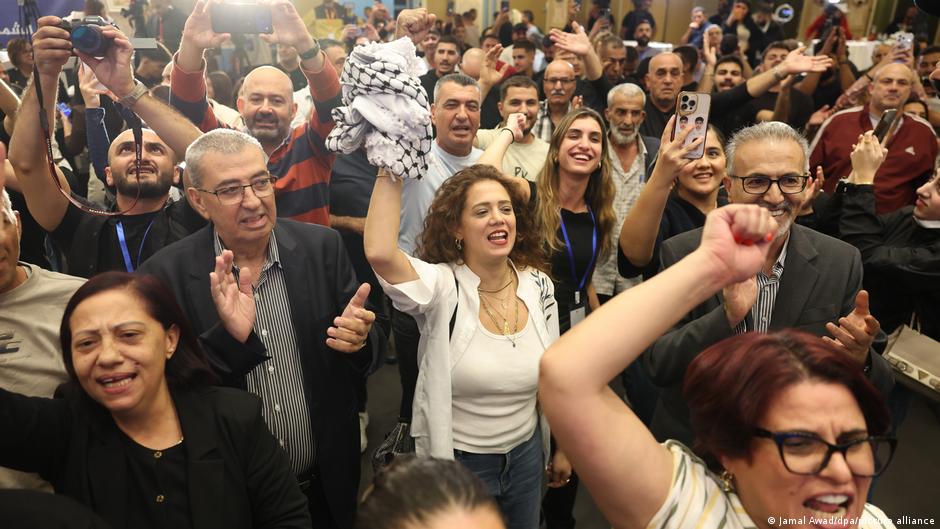
Israeli activists rally outside opposition leader Eisenkot’s home, urging him to join forces with Arab parties after ele

Global stories. Digital first.
Topic
Israeli activists rally outside opposition leader Eisenkot’s home, urging him to join forces with Arab parties after ele
Israel's final election results confirmed Prime Minister Benjamin Netanyahu’s bloc lost its majority of parliamentary seats and that weeks of difficult negotiations among very different parties, from ultra-Orthodox Jewish to secular to Arab-led, lie ahead. The results released early Friday showed Netanyahu’s bloc won 53 seats in Tuesday's elections. The main opposition bloc won 48. FRANCE 24's International Affairs Editor Philip Turle tells us more.
Benjamin Netanyahu's Likud party alleged on Thursday, without providing evidence, that Arab parties' record gains in an election this week were driven in part by voter fraud. These accusations represent an escalation of anti-Arab rhetoric by Netanyahu and his far-right partners after Arab-led parties made a historic showing in the election – giving them a potential kingmaker role in the next government
Israeli Prime Minister Benjamin Netanyahu's coalition won the most seats in the general election but fell eight short of a parliamentary majority, final results showed Friday. Arab party groupings emerged as potential kingmakers, while allegations of foreign interference threatened to complicate efforts to form a government.
Israel’s Prime Minister accused Palestinian-Israeli parties of election fraud.
The PM's Likud party has alleged foreign interference and said Arab-led parties "stole" the election after his coalition lost its majority.
Palestinian voters could decide Israel’s future, but its political class refuses to accept their mandate
From Netanyahu to Ben-Gvir, campaign boasts and attacks on Arab parties have been met with a deadlocked result.
Israel’s Central Elections Committee on Thursday called on the Shin Bet chief to investigate allegations of foreign interference in the elections, including suspected funding linked to Qatar. With more than 90% of the ballots counted, Prime Minister Benjamin Netanyahu's bloc has gained 53 seats, with the opposition at 67, including 48 for Gadi Eisenkot's centrist bloc and 19 for the Arab-majority parties. Follow our liveblog for the latest updates.
Israelis rallied for a Jewish-Arab gov’t after parties representing Israel’s Arab citizens made gains in the election.
Two Arab-majority parties are set to win a historic 19 seats in total, amid a record turnout at the polls in Israel on Tuesday. Voters from the community, descendants of Palestinians who stayed after Israel's creation and who make up around 20 percent of the population, have been enraged by the Netanyahu government's ultra-nationalist Jewish vision for the country and the Palestinian territories. FRANCE 24's Emerald Maxwell reports.
Erin Ogunkeye is pleased to welcome Dr. Shira Efron, RAND's Distinguished Israel Policy Chair. “Many of us, myself included, underestimated the extent of the fracture in Israeli society.” It reflects a political system in which ideological polarisation, the rightward shift of the Jewish electorate and the contested legitimacy of Arab political participation have sharply narrowed the possibilities for coalition-building. Dr. Efron illustrates a political landscape in which Netanyahu’s governing bloc has lost ground, yet still has “more cards, or better cards, to play,” she argues, whether throu
In Israel, the surprises only start with election night. They're still counting ballots in a vote that featured the highest turnout in decades, historic inroads by Arab parties and Benjamin Netanyahu's worst result since 1999. And yet, Israel's longest-serving prime minister still has a path to staying in power. As we await the definitive makeup of the next parliament, our panel breaks out the calculators and pie charts: in what scenario does Netanyahu survive? Is the issue with the right-wing Likud leader or his policies?
Elections have yielded no clear winner but opposition bloc refuses to ally with Arab parties.
The image claims to show Arab-Israelis queueing to vote, but BBC Verify analysis shows that it has been generated or manipulated by AI.
A new Israeli government is unlikely to bring big changes on Palestinian statehood and troops in Lebanon and Syria, experts say. Some small positives may be possible though.
Uncertainty hung over Israel’s election Wednesday as neither Prime Minister Benjamin Netanyahu’s right-wing, religious bloc nor the bloc formed by his centrist rival Gadi Eisenkot appeared to be heading for a majority in the Knesset. But there was a surprise: an unusually strong showing by Arab parties could make them unexpected kingmakers.
Oliver Farry is pleased to welcome Tamar Sebok, correspondent for the Israeli daily Yedioth Ahronoth, based in France. In an Israeli election marked by political uncertainty, unusually high voter participation and a significant mobilisation of Arab voters, the struggle for power extends far beyond the ballot box. As Sebok explains, the decisive question is not necessarily which party wins the most seats, but which political leader can assemble a viable governing coalition. “You don't know until the coalition is formed who really won,” Sebok explains, capturing the fundamental uncertainty of Is
Exit poll projections show that if Eisenkot’s bloc teamed up with Arab parties, they could potentially unseat Bibi.
With both blocs short of a majority, parties face a choice: to break the taboo on Arab allies or return to the polls.