Astronomers have watched two stars in the Andromeda galaxy fuse into one, a result NASA calls the first of its kind. Separate NASA announcements describe a far quicker way to find pulsars and the end of science work by the NICER X-ray telescope on the International Space Station.
Merger in the Andromeda galaxy
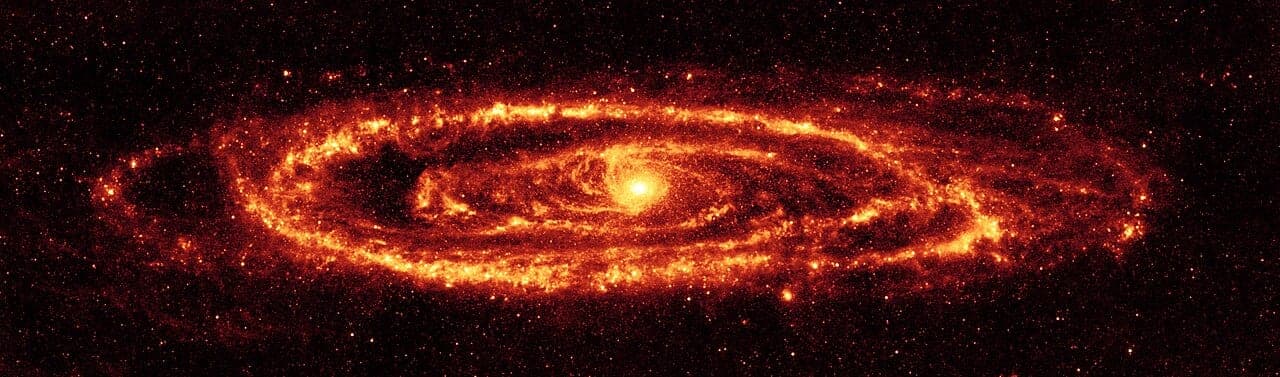
A companion with somewhat lower mass than the Sun was swallowed by a bloated supergiant at the edge of the neighboring Andromeda galaxy, leaving behind a single star. Researchers nicknamed it Bao, and its formal designation is AT 2025abao. The results appeared Wednesday in the journal Nature, and the research received NASA funding.
According to the team, the supergiant had seven times the Sun's mass, a radius 350 times larger and a brightness 18,000 times greater before the event. Its partner, nicknamed Little Bao, was put at about 0.7 solar masses. Once the companion touched the giant's surface, just seven orbits, roughly seven years, passed before they fused. NASA noted that previously known binary mergers involving two smaller stars needed thousands of orbits.
The story began in February 2023, when NEOWISE data revealed an odd variable star. WINTER recorded brightening and dust in September 2024, and SPHEREx noticed odd behavior in July 2025. The Zwicky Transient Facility caught the eruption on Oct. 17, 2025. Swift and Gemini North supplied observations in November 2025, and the James Webb Space Telescope looked on Dec. 24, 2025. First author Viraj Karambelkar said Webb's look came a mere 47 days past the outburst's peak, making it the soonest follow-up ever for this kind of event.
Following the merger as it happened let the team gauge the efficiency of the process known as common envelope evolution. In other cases, astronomers have had to reconstruct events that may date back hundreds or even millions of years. Karambelkar anticipates many more such finds as the Nancy Grace Roman Space Telescope carries out its surveys.
A much faster pulsar search
An international team has devised a technique that, according to NASA, speeds up the hunt for pulsars in openly available NASA data roughly a million-fold. The paper appeared Thursday in Physical Review Letters. Applying it to 15 years of Fermi Gamma-ray Space Telescope data, the researchers discovered PSR J1622−7204, an isolated pulsar that rotates 261 times per second. The computation equaled 10 hours on a standard processor, whereas the earlier best method missed the object even with 600 processor-years of effort.
The approach comes from Dotan Gazith and Barak Zackay of the Weizmann Institute of Science. It recasts the search as a geometry problem using algorithms from cryptography. Colin Clark of the Max Planck Institute estimated that tens, perhaps hundreds, of pulsars in binary systems remain hidden in the data, and said locating them is the next aim.
NICER ends science operations
NASA said on November 17, 2026 that its NICER X-ray telescope has ended science operations after outlasting its original mission by six and a half years. In June 2025, the instrument suddenly could not pivot side to side past the orientation it held at the time, which restricted its tracking of cosmic objects, and the team halted data collection. Engineers, after a lengthy probe, think the cause is a failed motor inside the telescope. Mission and station teams are now preparing to complete NICER's 8-year archive of X-ray data, then shut the instrument down and remove it from the station.
Sources
- NASA Science (Public domain (US government work))
- NASA Sciences & Exploration Directorate (Public domain (US government work))
- NASA (Public domain (US government work))
- NASA Science (Public domain (US government work))
- NASA (Public domain (US government work))
- NASA Science (Public domain (US government work))
- noirlab.edu