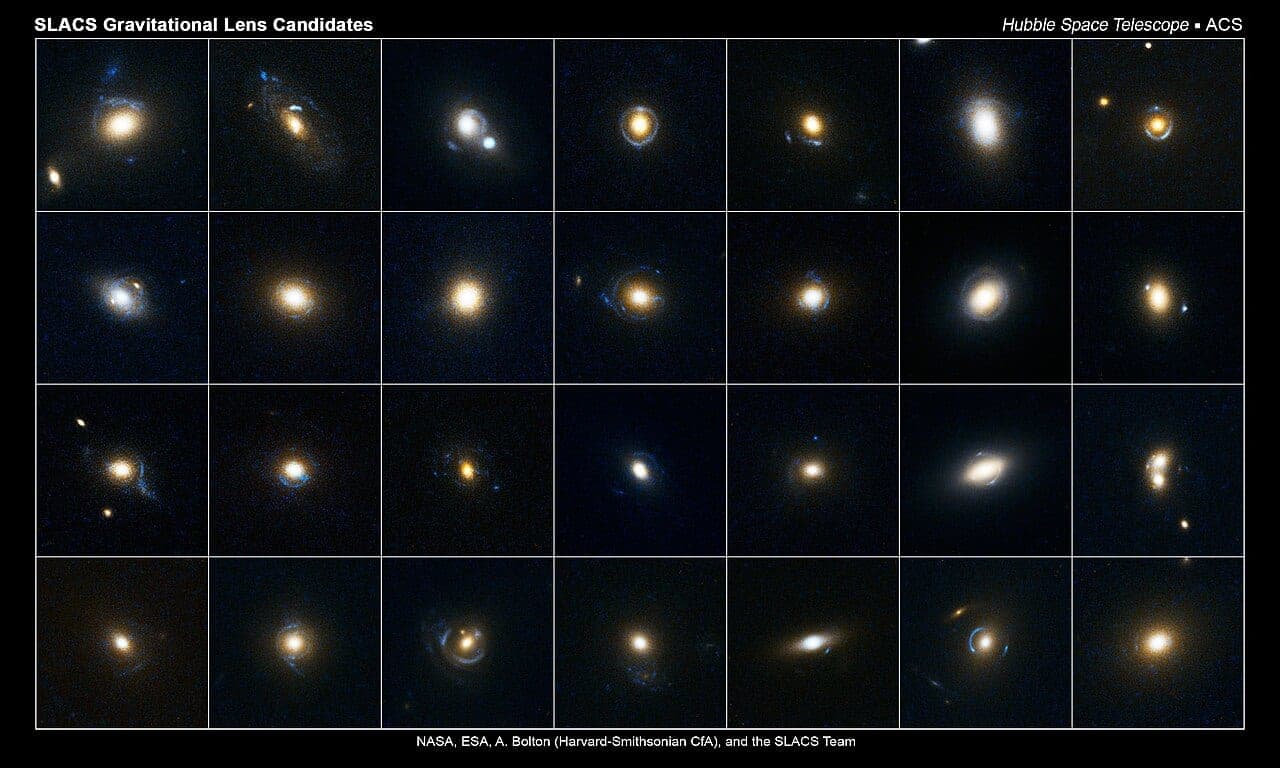
A new collection of Hubble Space Telescope images, showing distant galaxies bent into arcs by gravity, has two purposes, according to NASA. The images are expected to produce dark matter findings of their own and to prepare scientists for the much larger haul of such objects that the Nancy Grace Roman Space Telescope should deliver.
The objects are gravitational lenses, an effect Albert Einstein predicted. When a massive galaxy or galaxy cluster sits in front of a more remote one, its gravity distorts and magnifies the background light. It works like a natural lens that lets astronomers see further than any telescope could manage alone. In the gallery, each background galaxy lines up almost exactly behind a foreground galaxy, so it shows up as warped, enlarged arcs around the nearer object.
Hunting for small clumps of dark matter
The degree of distortion reveals how much mass the foreground galaxy holds and how that mass is spread out, including invisible dark matter. Researchers plan to turn a large, diverse sample of lenses into lens models for this purpose, and NASA said the effort might end up supporting or ruling out one theory of dark matter.
Hubble's sharpness is central to that test. Combined with precise models, its images should let researchers spot tiny irregularities in the arcs that would betray small, previously undetected clumps of dark matter. Finding them could confirm the cold dark matter theory, which holds that many such clumps exist, each weighing between a million and a billion times the Sun. For scale, the agency puts the dark matter halo surrounding the Milky Way at about 1.3 trillion solar masses.
Different telescopes, different jobs
Hubble works chiefly in visible and ultraviolet light, with limited infrared, and excels at detailed views of single objects. Roman relies mostly on infrared with some visible light and surveys far wider patches of sky, so it should catch many more lenses. If Roman turns up an especially intriguing example, Hubble may be called on for closer follow-up. Researchers also intend to use detailed study of the Hubble images to build a tool for efficiently finding comparable arcs in Roman data.
These strong lenses were first spotted with the Dark Energy Spectroscopic Instrument at Kitt Peak, then imaged by Hubble, and Roman is due to observe them later.
The lensing galaxies themselves
Most of the lensing galaxies in the gallery are ellipticals, which NASA describes as older, denser and more compact. Some are not, and researchers can use those exceptions to trace how the galaxies evolved. The foreground galaxies in panels B and F appear to have spiral arms, while the one in panel G looks stretched, though the agency says that could be a trick of perspective.
Panel D is unusual because its foreground galaxy carries a visible dust lane, a rare feature in a lens. NASA suggests the background galaxy there might in fact be an Einstein Ring whose appearance is interrupted by that dust. Because dust blocks infrared light less, Roman's infrared observations could reveal whether the arcs join into a fuller ring.
Rings, quads and colours
The lensed images themselves take several forms. Panel F shows an Einstein Ring, where the alignment is so exact that the background galaxy nearly wraps all the way around the lens. Panels C and I each show a background galaxy repeated four times; in C, double knots are probably intense star-forming regions. In panel A, two foreground galaxies together bend a background galaxy into a mirrored pair of arcs, a layout known as arc-counterarc.
Colour differs from arc to arc. Bluish arcs point to young stars and reddish ones to older stars, differences both telescopes will examine to learn how galaxies developed in the early universe.
Sources
- NASA Science (Public domain (US government work))
- NASA (Public domain (US government work))
- NASA Science (Public domain (US government work))
- NASA (Public domain (US government work))
- NASA (Public domain (US government work))
- NASA Scientific Visualization Studio (Public domain (US government work))