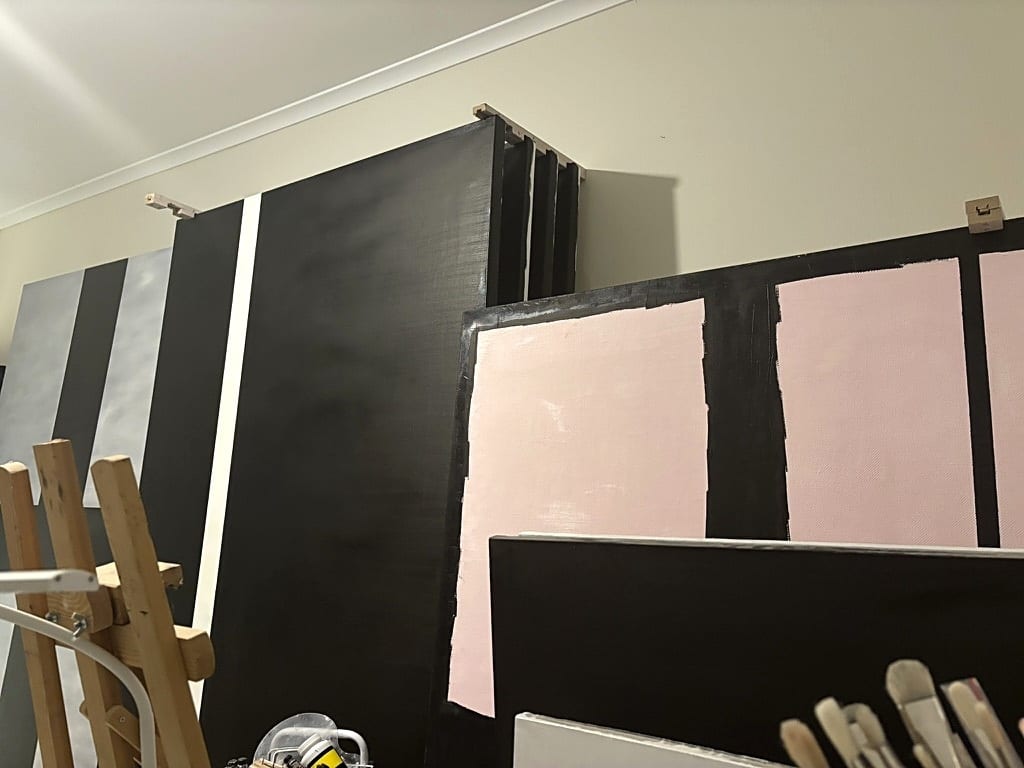
Catalan artist Jaume Amigó believes a painting does not need to convey violence and chaos as they are in order to take a stance on them. In an interview given to Global Voices, with questions posed by Omid Memarian, he said that painting lets him create another space for silence, contemplation and beauty, and that, by contrast, it may become a form of resistance.
Painting as a stance
Memarian asked what abstraction can offer in an age flooded with images of war, displacement and suffering. Amigó answered that artists cannot escape the current state of the world, and that he tries to search for another reality in which beauty, silence and natural cycles help him find his place, in a world saturated with ordinary and trivial images. He added that painting alone in the studio takes him away from that for a moment, but this distance does not mean ignoring it; rather, it makes him more aware of what is happening around him.
From memory to canvas
According to Amigó, he mostly starts from memory to paint what he saw outside his studio, so that many forms disappear and what he considers the most archetypal remains. He says that deciding between disappearance and survival is largely an act of intuition. He notes that he has used colored materials since he was young, so as to stay in direct contact with the earth and nature. He explained that many pieces are left neglected behind the studio for months or even years until he returns to them; they usually surprise him with joy and need only a little adjustment, and sometimes he paints over them in white and starts anew.
Japan and Morocco
According to the interview, Japan has been part of the artist's life for more than 30 years, and Morocco has become an important place in his work. Amigó considers himself a "collector of forms", and both countries have brought him new forms, materials and scents. As for Matsuo Bashō's book "The Narrow Road to the Interior", he says it has become part of how he understands painting: how to use emptiness, reduce colors, and say a lot with little. He believes form and emptiness carry the same weight in a painting, and that the idea of impermanence attracts him.
Who is Amigó
Amigó was born in Barcelona in 1963 and studied engraving and printmaking at the Llotja School of Higher Art and Design. Although painting is the foundation of his practice, he has also worked in sculpture, ceramics, installation and scenography. He lives in Alzina de Ribal in the Catalan region of Planoguera, and has exhibited his work in Spain, Japan, Morocco, the Netherlands and Switzerland.
Sources
- Global Voices الأصوات العالمية (CC BY 3.0)