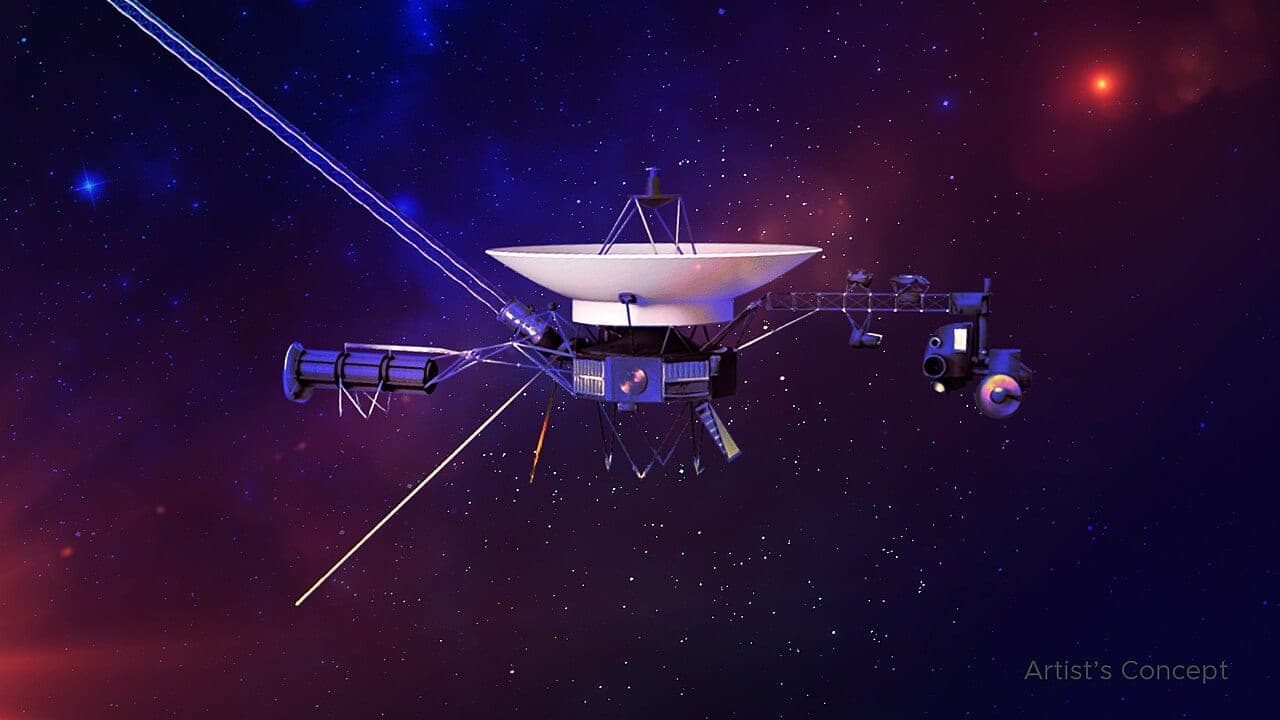
Voyager 1 has become the first human-made object to be one light-day away from Earth, according to NASA. The agency said the probe arrived at that distance at 2:16 a.m. PST (5:16 a.m. EST) on Nov. 18, more than 49 years into its mission.
NASA defines a light-day as the distance light covers in 24 hours, roughly 16.1 billion miles (25.9 billion kilometers). Staff at the Jet Propulsion Laboratory in Southern California, which Caltech manages, received a signal from the probe a day later, early Thursday. That delay matches how long a radio transmission at light speed needs to reach Earth from that distance.
Data interruption since Nov. 14
According to NASA, Voyager 1 has not returned any science or engineering data since Nov. 14. The probe is nonetheless emitting a carrier signal, which ordinarily carries that information to Earth. Mission engineers relied on the carrier signal plus trajectory calculations to verify the milestone, and the agency said they are still investigating what is disrupting the data.
Scale of the distance
NASA's announcement illustrated the scale this way: light from the Sun that has just gone past Earth arrives at the Moon roughly 1.3 seconds later, at Neptune after about four hours, and at Voyager 1 some 20 hours after that. The agency put the spacecraft's speed at about 38,000 mph (61,155 kph). Suzanne Dodd, Voyager project manager at JPL, said the team checks in with Voyager 1 daily and transmits commands once a week, and that a signal now takes 24 hours in each direction.
Its twin, Voyager 2, followed a different route and is expected to hit the same distance in November 2035, according to NASA Science. Voyager 1 is aimed toward the star AC +79 3888, also called Gliese 445. NASA Science says the probe should pass within roughly 1.7 light-years of that star in 40,000 years.
Power-saving measures on aging hardware
Both probes were launched in 1977. NASA said Voyager 1 left the heliosphere for interstellar space in 2012, while Voyager 2 crossed that boundary in 2018. The generator on each craft produces electricity from the heat of decaying plutonium, and each craft's available power drops by about 4 watts a year, the agency said.
Earlier this year engineers switched off three pieces of equipment aboard Voyager 1 and swapped in three alternatives that draw less power, a risky maneuver, NASA acknowledged. The agency expects the change to keep the current science instruments on both craft running at least through next summer, when each marks 50 years since launch.
Voyager project scientist Linda Spilker said it has been a big surprise how far the Sun continues to affect interstellar space, and that Voyager may last long enough to show where that influence ends.
Sources
- NASA (Public domain (US government work))
- NASA Science (Public domain (US government work))
- NASA Science (Public domain (US government work))
- NASA Science (Public domain (US government work))