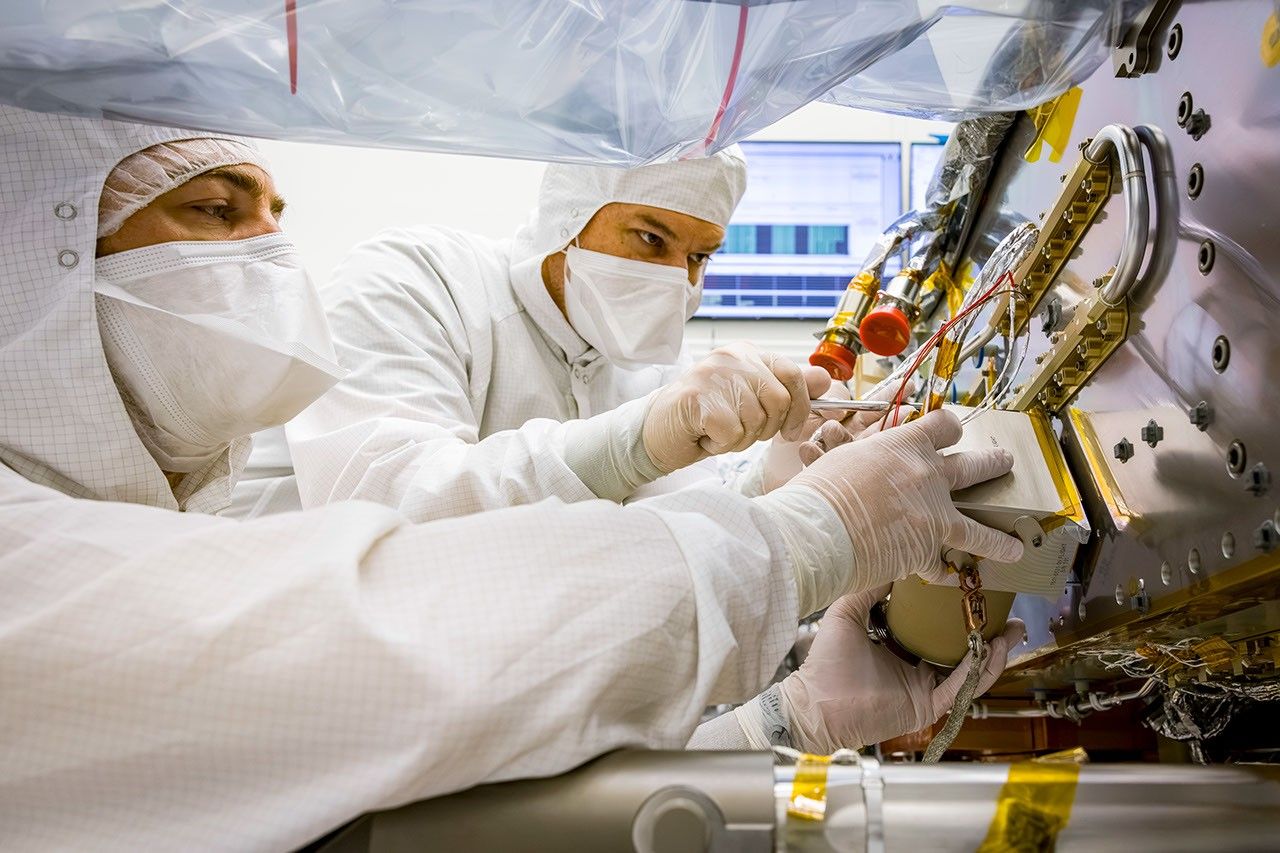
The rotorcraft NASA is sending to Titan, the largest moon of Saturn, is being assembled in Laurel, Maryland. According to NASA, the vehicle's first science instruments have begun showing up there, at the Johns Hopkins Applied Physics Laboratory (APL). The first delivery was DragonCam, a system of seven cameras.
What was installed
NASA says every one of the seven cameras came from Malin Space Science Systems, which both designed and built them. By mid-November, the team had mounted each camera in its insulated housing, checked it, and joined it to the rotorcraft. Titan is intensely cold, with surrounding temperatures as low as minus 290 degrees Fahrenheit, so a foam enclosure shields both the cameras and the inside of the vehicle. Each camera peers out through a window built into that foam, NASA said.
Separately, Dragonfly carries two navigation cameras, also from Malin, that went in this summer.
Layout of the camera system
The front of the vehicle has a wide-angle camera (WAC) and a medium-angle camera (MAC). The WAC has a 90-degree field of view; the MAC covers part of it in finer detail, and the pair together give a stereoscopic view. Two WACs on the sides extend this to panoramas of the landscape.
Two WACs pointing downward will let the team check the ground below before deciding whether a spot is safe for DrACO, the Drill for Acquisition of Complex Organics, and for the seismometer. A microscopic imager with high resolution will be trained on the drilling location to resolve sand grains measuring about a millimeter.
APL built a configurable LED array covering infrared through ultraviolet. NASA says it supplies information on surface color where samples are taken and helps scientists draw inferences about composition. The agency adds that in the darkness of a Titan night, which lasts nearly eight Earth days, these measurements might let DragonCam spot organic molecules that glow when struck by ultraviolet light.
Comments from the team
Carolyn Ernst, the DragonCam instrument scientist at APL, said the images will help tie samples collected at multiple sites to Titan's wider landscape and geology. Principal investigator Elizabeth Turtle called the installation an exciting milestone. Michael Ravine of Malin, the DragonCam development manager, said having the cameras aboard makes it easier to picture how they will work on Titan.
What comes next
NASA said parts of the remaining instrument packages, DraGNS, DraGMet, DraMS and DrACO, are slated to be delivered, integrated and tested across the coming months. The launch is planned for July 2028, with arrival at Titan in late 2034. The mission, chosen in 2019 as the fourth in NASA's New Frontiers program, has a planned duration of 3.3 years and will visit areas including dunes and Selk Crater.
Sources
- NASA Science (Public domain (US government work))
- NASA Science (Public domain (US government work))
- NASA Science (Public domain (US government work))