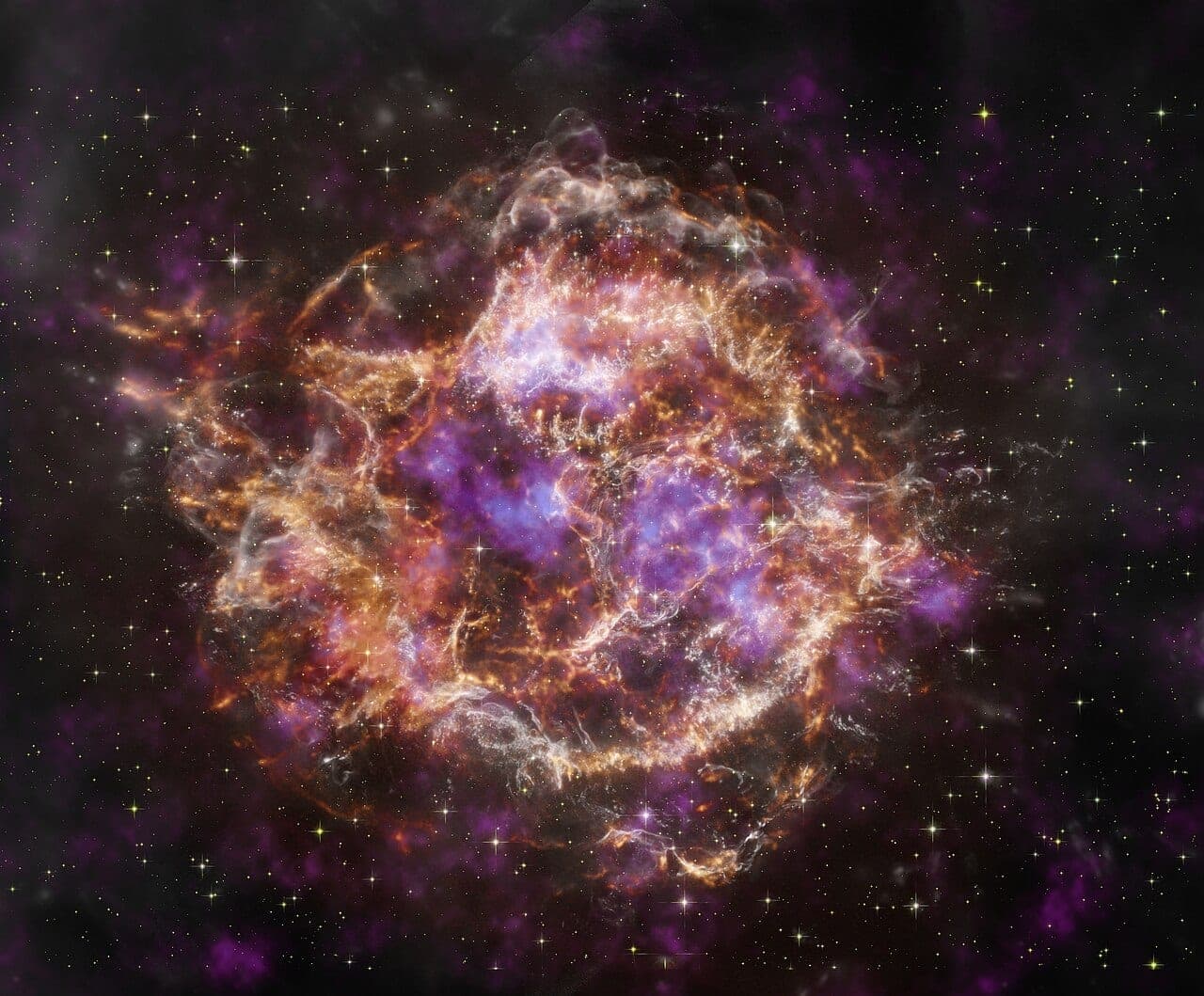
Dust in the supernova remnant Cassiopeia A (Cas A) may preserve a record of upheaval inside the doomed star shortly before it blew apart. According to NASA, new mid-infrared observations from the James Webb Space Telescope are consistent with a dramatic internal change in the star, possibly occurring only hours before its death. The study appeared Monday in The Astrophysical Journal Letters, and NASA issued the accompanying high-resolution image on Nov. 23, 2026.
The researchers present the timing as an interpretation, not a settled fact. Co-author Dan Milisavljevic, an associate professor at Purdue University, described the findings this way: "It's telling us about what was happening, we think, in the hours leading up to core collapse."
Reading a star's history in its dust
NASA explains that massive stars build up nested layers of elements as they age, with heavier elements forged toward the core and lighter ones burning in the layers around it. When such a star explodes, those elements are flung outward, and some condense into grains that gather into clumps. By analysing the makeup of clumps in Cas A, each roughly as large as the solar system, Webb found signs of what astronomers call a shell merger, in which the star's internal layers blend together ahead of the blast.
Lead author Tea Temim, a research scientist at Columbia University, said churning material can cause shells to combine, citing the joining of oxygen- and carbon-burning layers as an example. According to Temim, that kind of restructuring would alter the chemical mix later found in a remnant's ejecta.
Evidence across the remnant
Webb's survey of dust makeup covered the whole of Cas A, extending prior X-ray work by two other missions: Chandra, operated by NASA, and XRISM, which Japan's JAXA leads. NASA says the combined results point to a merger that was in progress very shortly before the explosion, and that its chemical fingerprints show up across much of the remnant.
Archival data from the now-retired Spitzer Space Telescope, which lacked Webb's sharpness, helped the team choose three areas for closer study:
- Two sit in Cas A's reverse-shocked zone, where shocked debris is being slowed by a wave pushing back toward the centre. Silica dominated the dust in one; carbon dominated the other.
- The third, a feature nicknamed the "Green Monster" that Webb itself first discovered, proved rich in complex magnesium silicates. NASA says this material was cast off by the star before it exploded rather than produced by the supernova.
Why it matters
Milisavljevic said the ability to examine single clumps permits more detailed dust chemistry, letting scientists link the explosion to the progenitor's composition centuries later. He added that understanding the process helps explain which elements a supernova delivers to the galaxy and how they feed later stars and planets. NASA says the approach gives other astronomers a fresh technique for deducing a parent star's structure from remnant dust.
A 2005 Spitzer release put Cas A 10,000 light-years away in the constellation Cassiopeia, described it as a neutron star encircled by a shell of expelled material, and called it the most recent supernova in the Milky Way.
Sources
- NASA (Public domain (US government work))
- NASA Science (Public domain (US government work))
- www.spitzer.caltech.edu
- NASA (Public domain (US government work))
- cxc.harvard.edu