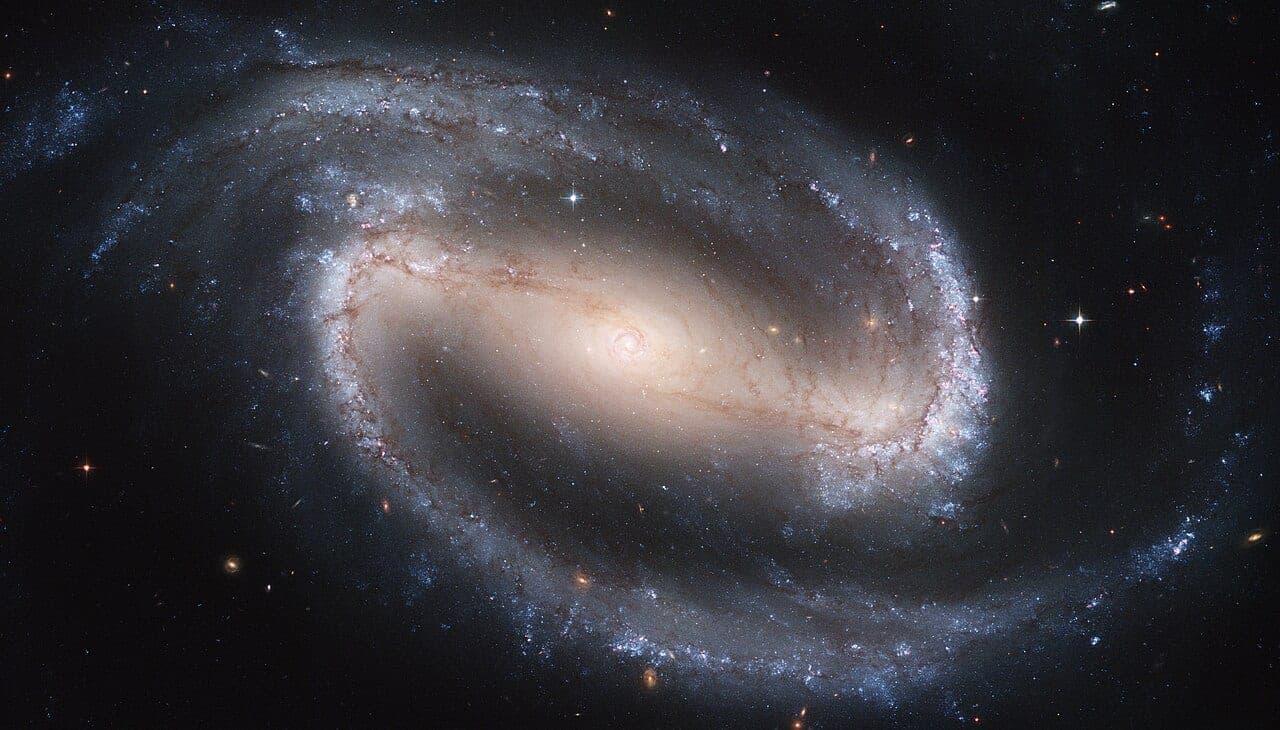
NASA has published a Hubble Space Telescope image of NGC 4394, a spiral galaxy with a distinct bar of stars across its center. According to NASA, the galaxy sits in the constellation Coma Berenices, roughly 55 million light-years from us, a distance the agency calls relatively close by galactic standards. It is one of more than 1,000 members of the Virgo Cluster, the nearest galaxy cluster.
A possible Milky Way look-alike
NASA says the galaxy's spiral arms and central bar make it a close match for what astronomers think our own galaxy would look like if viewed face-on. The two may also have something else in common: each might host a LINER, short for low-ionization nuclear emission-line region. This is a zone near a galaxy's core where the spectrum shows particular ionized or neutral elements. NASA states that the exact origin of LINERs is still unknown, with supermassive black holes that are actively feeding, or vigorous star formation, probably involved.
Why bars form and fade
Bars are widespread. NASA reports that astronomers estimate 65 percent of nearby spiral galaxies have one. Proposed explanations generally begin with the stellar disk turning unstable, perhaps triggered by the pull of galaxies passing by, by stars influencing one another, or by other forces. Once that happens, stars' circular paths stretch out, producing the bar shape.
According to NASA, observations show bars occur more often in today's universe than they did several billion years ago. The agency adds that research suggests this is only a temporary phase, because a bar that grows more massive can itself become unstable.
Two observing programs behind the picture
An earlier Hubble picture of NGC 4394 appeared a decade ago. It came from program 10515 (principal investigator Peng), which targeted the neighboring galaxy Messier 85. One instrument examined that galaxy's unusual star clusters, while Hubble's Advanced Camera for Surveys recorded a parallel patch of sky containing NGC 4394.
The new image also incorporates data from a recent program, 18103 (principal investigator Thilker). That effort aims to understand how star formation ends in galaxies within dense clusters, and how this differs for more isolated galaxies in the field. Using Hubble's Wide Field Camera 3, which is sensitive across a broad range of wavelengths, researchers worked out the ages of individual star clusters. NASA says NGC 4394 was among 40 galaxies examined that way.
Sources
- NASA Science (Public domain (US government work))
- NASA (Public domain (US government work))
- NASA Science (Public domain (US government work))
- www.spitzer.caltech.edu
- NASA (Public domain (US government work))
- cxc.harvard.edu